Directives and Regulations
EU Declaration of Conformity. What Will Change for Machinery from 2027?
What changes in the EU Declaration of Conformity for machinery from 20 January 2027: required details, standards, modules and digital format.
For almost twenty years, we have prepared a document known as the EC Declaration of Conformity. From 20 January 2027, it will become the EU Declaration of Conformity.
Two letters change, but unfortunately that is not the end of it.
It is not enough to take the old document and replace “EC” with “EU”: the resulting document would not be ready for use. Regulation (EU) 2023/1230 changes the structure of the declaration, introduces new information and links its content more explicitly to product traceability, the standards applied and the conformity assessment procedure selected.
The old template may provide a starting point, but it cannot be reused without the appropriate changes.
First of All: Which Declaration Should Be Used?
The arrival of 20 January 2027 will not suddenly make declarations drawn up under Directive 2006/42/EC incorrect.
For machinery placed on the market or put into service under the Directive, the correct document remains the EC Declaration of Conformity provided for in Annex II. Machinery subject to the new Regulation will instead require the EU Declaration of Conformity provided for in Article 21 and Annex V.
The choice of template does not depend on the day on which the document is printed or signed. It depends on the legislation applicable to the specific machine when it is placed on the Union market or put into service.
This is the same distinction examined in Machinery delivered in 2027: Directive or Regulation?: the order, invoice and physical delivery do not, on their own, settle the matter.
The Main Differences
| Directive 2006/42/EC | Regulation (EU) 2023/1230 |
|---|---|
| EC Declaration of Conformity | EU Declaration of Conformity |
| Refers to machinery as defined by the Directive | Distinguishes between machinery and related products and expressly addresses substantially modified machinery or related products |
| Requires the name and address of the person authorised to compile the technical file | This information no longer appears among the particulars required in the declaration |
| Identifies machinery by its generic denomination, function, model, type, serial number and commercial name | Requires identification allowing traceability and permits a clear colour image to be included where necessary |
| Requires, where appropriate, references to the harmonised standards applied | Requires more precise references and expressly addresses partial application |
| Identifies the notified body where one has been involved | Links the declaration to the conformity assessment modules and requires Module A to be stated where applicable |
| Must accompany the machinery | May also be made available through an internet address or machine-readable code |
| Does not regulate online accessibility of the declaration | A digital declaration must remain accessible throughout the expected lifetime and, in any event, for at least ten years |
The comparison is based on Annex II, Part 1, Section A of Directive 2006/42/EC and Article 21 and Annex V, Part A of Regulation (EU) 2023/1230.
The Person Authorised to Compile the Technical File Disappears from the Declaration
This is one of the most evident differences for anyone accustomed to working with Machinery Directive templates.
The EC Declaration must state the name and address of the person authorised to compile the technical file, who must be established in the Community. This field is not required in the template established by the new Regulation.
Removing it from the declaration does not reduce the manufacturer’s obligations concerning technical documentation. The technical file must still be prepared, retained and made available to the authorities under the conditions laid down by the Regulation. A piece of information disappears from the public document, but the responsibility for demonstrating machinery conformity does not.
This distinction matters because updating the template is not simply a matter of deleting a field or a line. The manufacturer must rigorously verify that its organisation knows who manages the documentation and, above all, how it can be retrieved promptly.
Indicating the Technical Standards
Current declarations still sometimes contain lists of standards copied from an earlier template, standards found through a casual internet search, references without an edition or standards included because “they are normally listed”.
The new Annex V makes this practice inadequate.
For the harmonised standards applied, the declaration must provide the references required by the Regulation, including the date on which the reference was published in the Official Journal of the European Union. Other technical specifications must also be identified by date. Where a harmonised standard or common specification has been applied only in part, the parts actually applied must be specified.
It is therefore not enough for a standard to be technically relevant. A distinction must be made between a published standard, a standard harmonised under the Regulation and other technical specifications used for the design.
The declaration must also remain consistent with the risk assessment, design verifications and evidence retained in the technical documentation.
The declaration should not be the place where the manufacturer discovers which standards were applied. It should be the final result of a design process and of decisions already documented in the risk assessment.
It Will Be Necessary to Indicate the Conformity Procedure in the Document
The Directive requires the notified body to be identified where it has performed an EC type-examination or approved a full quality assurance system.
The Regulation instead adopts the European module structure. Where applicable, the declaration must state whether EU type-examination under Module B was followed by conformity to type based on internal production control under Module C, or whether conformity was assessed through unit verification under Module G or full quality assurance under Module H. It must also indicate when the machinery or related product is subject to internal production control under Module A.
This detail has a much broader significance than simply naming a module. It makes the selected conformity assessment procedure visible and consequently requires the manufacturer to verify that the procedure is actually permitted for that machinery.
The declaration template cannot be completed correctly before the product has been classified, its possible inclusion in Annex I has been checked and the applicable procedure has been identified.
For Certain Machinery, the Place of Installation Also Enters the Declaration
The new template introduces specific information for lifting machinery intended to be permanently installed in a building or structure where it cannot be assembled at the manufacturer’s premises and can only be assembled at the place of use.
In these cases, the declaration must state the address of that place.
This is a significant change. It links the document not only to the model and serial number, but also to the configuration completed at a specific site. For this machinery, a generic declaration prepared before installation may not contain all the required information.
One Declaration for All Applicable Union Legislation
Machinery is often subject to other Union legislation, such as legislation on electromagnetic compatibility, radio equipment or potentially explosive atmospheres, as well as any other acts relevant to the product’s configuration.
The Regulation expressly establishes that, where several Union legal acts require an EU Declaration of Conformity, a single declaration must be drawn up covering all applicable acts and stating their publication references.
Many manufacturers already work in this way. From 2027, however, this will not merely be a convenient documentary solution: it will be an explicit requirement of Article 21.
A single declaration does not necessarily mean that every assessment must be compressed onto one page. Recital 52 allows the single declaration to take the form of a file comprising the relevant individual declarations. What must be presented as a coherent whole is the legislative framework declared for that machine.
The Declaration May Be Digital, but It Must Always Remain Accessible
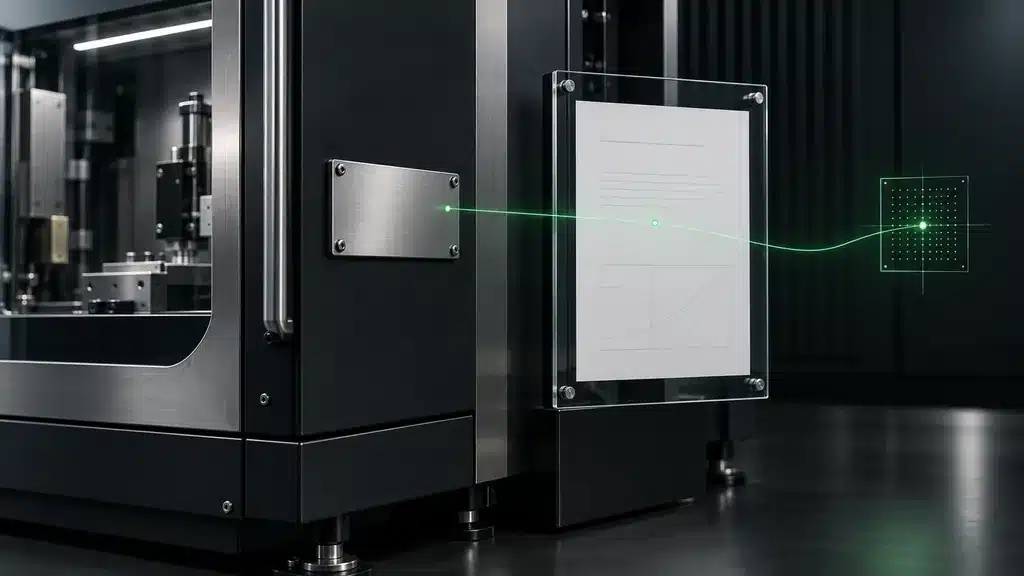
The Regulation allows the manufacturer either to accompany the machinery with the declaration or to include in the instructions an internet address or machine-readable code through which it can be accessed.
This is an interesting option, but it raises a very practical issue: a link that works on the day of delivery must continue to work after a change of website, platform or document management system.
A digital declaration must remain accessible online throughout the expected lifetime of the machinery or related product and, in any event, for at least ten years after it has been placed on the market or put into service.
Uploading a PDF to a folder that will be reorganised during the next website update is therefore not enough. A stable publication system is needed, with permanent links, controlled versions and an unambiguous association between the declaration and the individual machine.
There is also a common misunderstanding worth addressing. The right to receive the instructions in paper format free of charge, where requested by the user at the time of purchase, applies to the instructions for use. The manufacturer must provide them within one month.
Article 10(8) does not establish the same requirement for the EU Declaration of Conformity, which may be supplied solely in digital form.
The New Template Should Be Prepared before 2027
The worst time to update a declaration is when the machinery is ready to leave and someone discovers that the information discussed in this article is missing.
The new template should be developed together with the process that supplies its information. Machinery details should come from the order data; standards from the technical assessment; the conformity assessment procedure from product classification; and legislative references from the analysis of the applicable directives and regulations.
It makes sense to prepare a controlled template now and test it on a selection of representative machines. This is not about issuing declarations early under legislation that does not yet apply. It is about identifying where the organisation does not yet hold the necessary information and ensuring that it is ready to revise its declaration of conformity in 2027.
The Shape of the New Document
The change from EC to EU may look like a purely formal update. In reality, the structure of the new document follows a more explicit sequence: identification of the product, applicable Union legislation, technical references, conformity assessment procedure and assumption of responsibility by the manufacturer.
The declaration is not a certificate issued by the European Union. On its own, it is not proof that every verification has been performed. Nor can it remedy technical documentation that is incomplete or incorrect.
A properly drafted declaration does not make non-compliant machinery compliant. An inconsistent declaration can, however, make it much more difficult to demonstrate the conformity of machinery that has been correctly designed.
The name of the document will change on 20 January 2027, but its most important feature will remain the same: every line in our declaration must be capable of being substantiated.
Frequently Asked Questions
Will every existing EC Declaration need to be updated on 20 January 2027?
No. Declarations correctly drawn up for machinery placed on the market or put into service under Directive 2006/42/EC do not become invalid merely because the date has passed. The EU template must be used for machinery and related products to which the new Regulation applies.
May the EU Declaration of Conformity be supplied solely in digital form?
Yes. The manufacturer may provide an internet address or machine-readable code in the instructions through which the declaration can be accessed. The digital document must remain accessible throughout the expected lifetime and, in any event, for at least ten years after the machinery or related product has been placed on the market or put into service.
Is a person authorised to compile the technical file no longer needed?
The person’s details are no longer required in the EU Declaration set out in Annex V. The manufacturer’s obligations to prepare, retain and make the technical documentation available to the competent authorities remain unchanged.
Is a number mandatory for the EU Declaration of Conformity?
No. The note to Annex V states that assigning a number to the declaration is optional. Where a manufacturer uses a numbering system, it should nevertheless be managed consistently and provide an unambiguous link to the machinery concerned.