Directives and Regulations
Responsibilities of EU importers of machinery and other products
Original-brand resale, own branding, direct use or integration: different operations, different roles and responsibilities to establish before ordering.
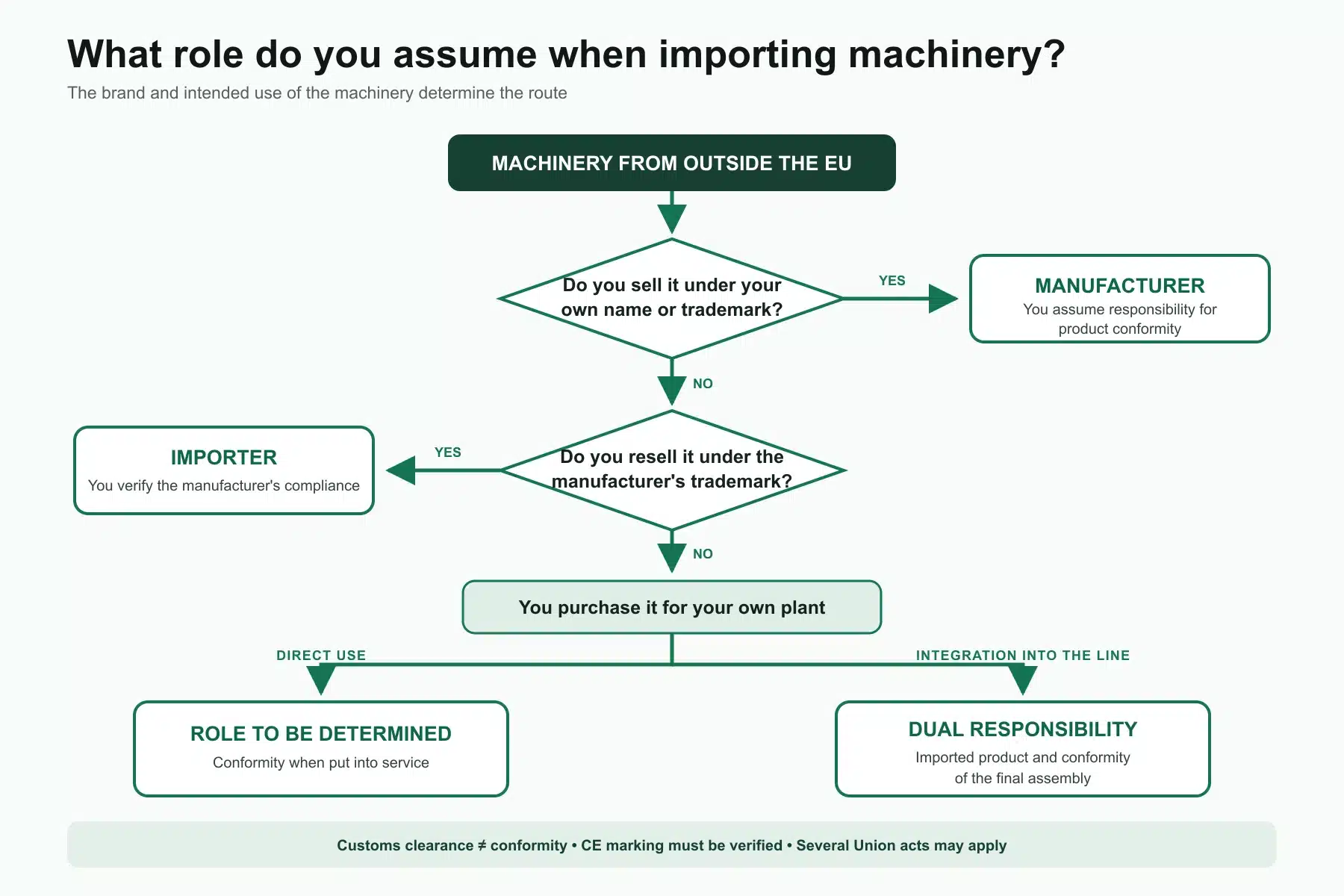
A European company purchases machinery from a manufacturer outside the EU:
- If it resells the machinery under the original brand, it may assume the role of importer.
- If it markets the machinery under its own brand, it assumes the obligations of the manufacturer.
- If it installs the machinery at its own plant or imports a module for integration into a line, putting into service, workplace safety and the conformity of the final assembly also come into play.
For the purchasing department, all three operations may begin with the same purchase order. Under EU product legislation, however, they are not equivalent. Responsibility depends on the product, the contract, the brand used, any modifications made and the party carrying out the first placing on the Union market.
Together with the Waves Engineering article on technical checks before importing machinery, this article provides a complete view of an increasingly relevant issue: what role does the European company assume, and which obligations follow from that role?
Importing is not merely a customs operation
Regulation (EU) 2019/1020 defines an importer as a natural or legal person established within the Union who places a product from a third country on the Union market. Placing on the market is the first making available of an individual product on the Union market. It does not necessarily coincide with the product’s physical arrival at customs and must be assessed correctly for each supply transaction.
The European Commission’s 2022 Blue Guide clarifies a frequently overlooked point: release for free circulation does not prove conformity. Customs clearance allows a product to enter the Union customs territory, but it does not certify that the conformity assessment, marking, instructions or technical documentation are correct.
Moreover, the term importer does not describe the same obligations for every product. Machinery, electrical equipment, radio equipment, pressure equipment, personal protective equipment and consumer products are governed by different legal acts. The underlying logic for economic operators is similar, but the documents, procedures and checks must be assessed under the legislation applicable to the specific product. CE marking must be affixed only where required by a Union act.
Two legal regimes apply to machinery
Directive 2006/42/EC continues to apply until 19 January 2027. Unlike more recent EU acts, the Directive does not contain a separate chapter setting out importer obligations. Article 2 nevertheless treats as a manufacturer any person who designs or manufactures machinery and assumes responsibility for its conformity with a view to marketing it under that person’s own name or trademark, or for that person’s own use. Where no manufacturer can be identified in this way, the person who places the machinery or partly completed machinery on the market, or puts the machinery into service, is considered to be the manufacturer.
Regulation (EU) 2023/1230 will apply from 20 January 2027. Articles 13 and 14 expressly set out obligations for importers of machinery, related products and partly completed machinery. Article 17 also establishes when an importer or distributor is to be considered a manufacturer: this occurs when the operator places the product on the market under its own name or trademark, or modifies it in a way that may affect conformity with the applicable requirements.
The transition does not allow companies to choose freely between the two regimes. The applicable legislation depends on the individual item of machinery and on the legally relevant event. For projects spanning 2027, it is therefore necessary to establish when the machinery was completed, made available, placed on the market and put into service.
The importer’s core responsibilities
Under the new Machinery Regulation, an importer may place only compliant products on the market. Before doing so, the importer must ensure that the manufacturer has carried out the appropriate conformity assessment procedure, drawn up the required technical documentation, affixed the CE marking where required and supplied the prescribed documents. The importer must provide its contact details, ensure that the required instructions or assembly instructions accompany the product and prevent storage or transport conditions from jeopardising conformity.
Where appropriate in view of the risks, the importer must carry out sample testing, investigate complaints and recalls, and keep registers where required. If a non-conformity is identified, the importer must ensure that the necessary corrective action is taken and, where the relevant conditions are met, inform the competent authorities. For at least ten years, the importer must keep a copy of the EU declaration of conformity or the EU declaration of incorporation and ensure that the technical documentation can be made available to the authorities.
This does not mean that an importer must always hold the entire technical documentation. It does mean, however, that the importer cannot simply receive a declaration and hope that the manufacturer will respond at some point in the future. The relationship with the supplier must make it possible to obtain, within the required time, the information needed to demonstrate conformity. The following sections examine three representative import scenarios.
Case one: reselling an imported product under the original brand
The European company purchases the machinery from a manufacturer outside the EU and resells it while retaining the original manufacturer’s name and trademark. In this situation, the company normally acts as the importer. Adding its own importer contact details does not, in itself, make the European economic operator the manufacturer, provided that the product continues to identify the original manufacturer correctly.
The importer’s responsibility is to verify that a coherent conformity route exists. The declaration must identify the machinery actually supplied; the instructions, rating plate, diagrams and configuration must correspond; and the procedures used must be permitted for that product. If there are reasonable grounds to believe that the machinery is not compliant, it must not be placed on the market until it has been brought into conformity. The importer’s contact details must appear on the product or, where the product’s size or nature makes this impossible, on its packaging or in an accompanying document.
A contract that assigns all responsibility to the manufacturer outside the EU does not remove the importer’s statutory obligations. It may allocate warranties, access to documents and costs, but it cannot erase the role of the European operator in relation to the authorities.
Case two: selling imported machinery under your own brand
Where a European economic operator replaces the manufacturer’s name with its own name or trademark, the issue changes fundamentally. The operator is no longer merely checking another party’s work; it is presenting itself on the market as the manufacturer. This conclusion is already consistent with the definition in Directive 2006/42/EC and is stated explicitly in Article 17 of Regulation (EU) 2023/1230.
The declaration signed by the manufacturer outside the EU cannot simply be reused with a different logo. The company assuming the manufacturer’s role must be able to control the risk assessment, the conformity assessment procedure, the technical documentation, the instructions, the declaration and the marking. It must also know which product variants, software and hardware changes, and test evidence support the technical solutions adopted.
Private-label supply is therefore sustainable only where the agreement with the manufacturer provides genuine access to design data and includes effective change control. If the supplier changes a guard, drive, control software or safety component without informing the brand owner, the European manufacturer’s documentation may cease to represent the machinery being sold.
Case three: importing for direct use or integration
A direct purchase for use at the company’s own plant requires a specific assessment, whether it concerns machinery or another type of component. In this scenario, the European purchaser does not automatically act as an importer in every supply structure. The Blue Guide explains that a product may be shipped directly from a manufacturer outside the EU to an end user without a separate importer, provided that the economic operator established in the Union required by the applicable legislation is present. The contract, supply flow and identification of the operators must therefore be assessed together.
For machinery, putting into service remains decisive. Directive 2006/42/EC treats the person putting machinery into service as the manufacturer where no manufacturer can be identified under its definition; the new Regulation governs both placing on the market and putting into service. The absence of a resale transaction does not make non-compliant machinery lawful to use.
Where machinery is made available to workers, the employer’s obligations under the national legislation transposing Directive 2009/104/EC also apply, including, in Italy, Legislative Decree 81/2008. Product conformity and safety in use are related but distinct: correct CE marking does not replace the assessment of the workplace, installation, interfaces, maintenance and training.
Where a component is imported for integration into a line, it must first be classified correctly. An ordinary component, a safety component, partly completed machinery and complete machinery do not require the same documentation. Requesting an EC declaration indiscriminately for every component is a mistake; accepting partly completed machinery as though it were complete machinery is equally wrong.
From 20 January 2027, for partly completed machinery, Regulation (EU) 2023/1230 will require the importer to verify the technical documentation specified in Annex IV, Part B, the EU declaration of incorporation, the assembly instructions and the identification details. The party creating the complete machinery or final assembly must then assess the risks generated by integration, manage the interfaces and assume the manufacturer’s obligations for the final product. The Waves article on partly completed machinery examines this step in greater detail.
Three operations compared
| Operation | Main role | Core responsibility | Mistake to avoid |
|---|---|---|---|
| Resale under the original brand | Importer | Verify the manufacturer’s conformity route and manage traceability, documents and corrective action | Treating CE marking as sufficient evidence |
| Sale under own brand | Manufacturer | Assume responsibility for the risk assessment, technical documentation, declaration and change control | Replacing the manufacturer’s logo and signature on its documents |
| Direct use or integration | Role to be determined and possible manufacturer of the assembly | Check the imported product and demonstrate conformity of the configuration put into service | Confusing component conformity with conformity of the line |
The same logic applies to other products
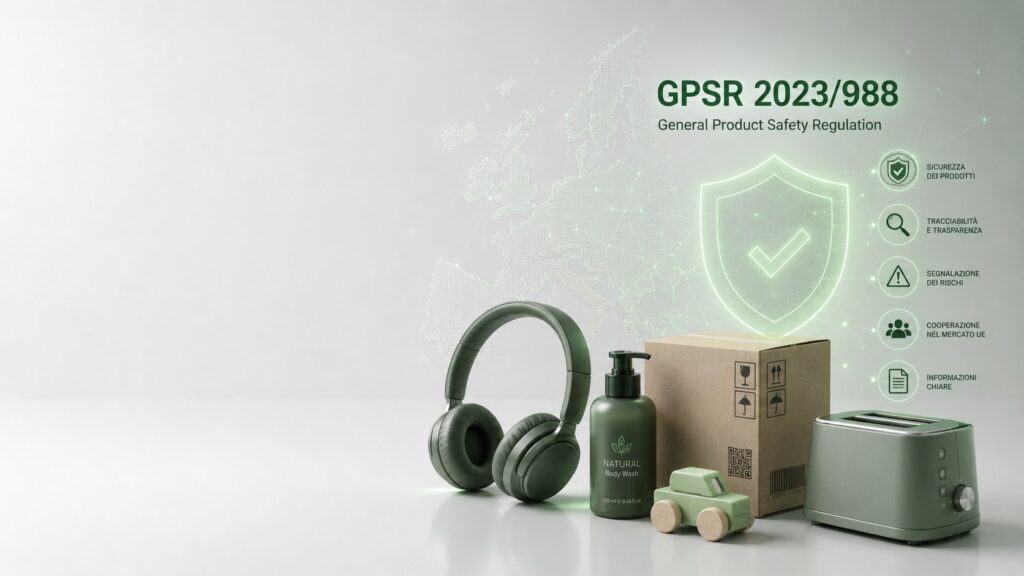
The shift from importer to manufacturer is not limited to machinery. Many Union harmonisation acts assign the manufacturer’s obligations to a person who places a product on the market under its own name or trademark, or modifies it in a way that may affect conformity. Regulation (EU) 2023/988 on general product safety contains a comparable rule for consumer products within its scope.
Before purchasing any product from outside the EU, the company should therefore prepare a map of the applicable legislation. An electrical control panel, radio device or pressure equipment may fall under different legal acts and often under several acts simultaneously. The first question is not whether a ‘CE certificate’ exists, but which requirements apply, who must fulfil them and what evidence must accompany the product.
Practical guide before placing the order
- Define the actual product and the configuration intended for the Union, distinguishing between machinery, partly completed machinery, a safety component and an ordinary component.
- Identify every applicable EU act and determine whether it requires CE marking, a declaration, the involvement of a notified body or other obligations.
- Map the supply chain and assign the role under each applicable act: manufacturer, importer, authorised representative, distributor, end user or integrator.
- Include contractual provisions covering access to documents, notification of changes, required languages, management of non-conformities and cooperation during inspections or recalls.
- Before shipment, examine declarations, markings, instructions, diagrams and the principal technical evidence; where the risk warrants it, plan a physical product inspection.
- On arrival, check the product’s identity and configuration and inspect it for transport damage. For integration, verify the mechanical, electrical and software interfaces, together with any shared safety functions.
- Maintain an import dossier linking the order, product, version, documents, checks, anomalies and corrective actions. For a line, connect this dossier to the technical documentation for the final assembly.
Questions that must be answered
Is the party paying customs duties and transport always the importer?
No. Commercial and customs terms are relevant, but the role under product legislation depends on who places the product on the market and on the actual structure of the supply transaction.
Can I sell machinery under my own brand using the original manufacturer’s declaration?
Not by simply changing the name or logo. A company that uses its own name or trademark assumes the manufacturer’s obligations and must have the documentation needed to support them.
Does imported partly completed machinery require CE marking?
Not under machinery legislation solely because it is partly completed machinery. It must be accompanied by a declaration of incorporation, known as the EU declaration of incorporation from 20 January 2027, and by assembly instructions. Any other applicable Union acts must be assessed separately.
Is used machinery from a third country excluded?
No. Where it enters the Union market for the first time, used or second-hand machinery must also be assessed against the legislation applicable at the time it is placed on the market.
Responsibility is determined before shipment
The most useful time to determine the European company’s role is before the order is placed, not when the machinery is already held at customs or ready for commissioning. The brand, intended use, level of integration and availability of documentation must be defined while the contract and the design can still be influenced.
Waves Engineering supports importers, end users and integrators with product classification, analysis of the applicable legislation, document reviews and technical checks before shipment and putting into service. Our international regulations service and machinery safety services help coordinate market requirements, design decisions and documentation.
Main sources
- Regulation (EU) 2023/1230, Articles 3, 13, 14, 17, 18, 19, 51 and 54
- Directive 2006/42/EC, Articles 2, 5 and 13
- Regulation (EU) 2019/1020, Articles 3 and 4
- European Commission, The ‘Blue Guide’ on the implementation of EU product rules 2022, Sections 2.3, 2.5, 3.1 and 3.3
- Directive 2009/104/EC, Articles 3 and 4
- Regulation (EU) 2023/988, Articles 11 and 13