Regulations
Machinery instructions for use: EN ISO 20607 and Regulation (EU) 2023/1230
How to write a instructions for use for machines: content, EN ISO 20607, Machinery Regulation and risks to avoid.
Because the instructions for use is a technical document and not only formal
Machinery instructions for use are not a formality to be dealt with at the end of a project. They are central to CE conformity, giving users the information needed to operate the machinery correctly, safely and within the limits specified by the manufacturer.
A badly written instructions for use creates two problems: it increases the operating risk for those who use the machine and weakens the technical position of the manufacturer in case of disputes, accidents, checks or requests of the market supervisory authority.
For this reason, the editing of the instructions for use must be linked to the design, analysis of risks, selection of protective measures and documentation collected in the technical file. Reference
What information must contain the instructions for use of a machine
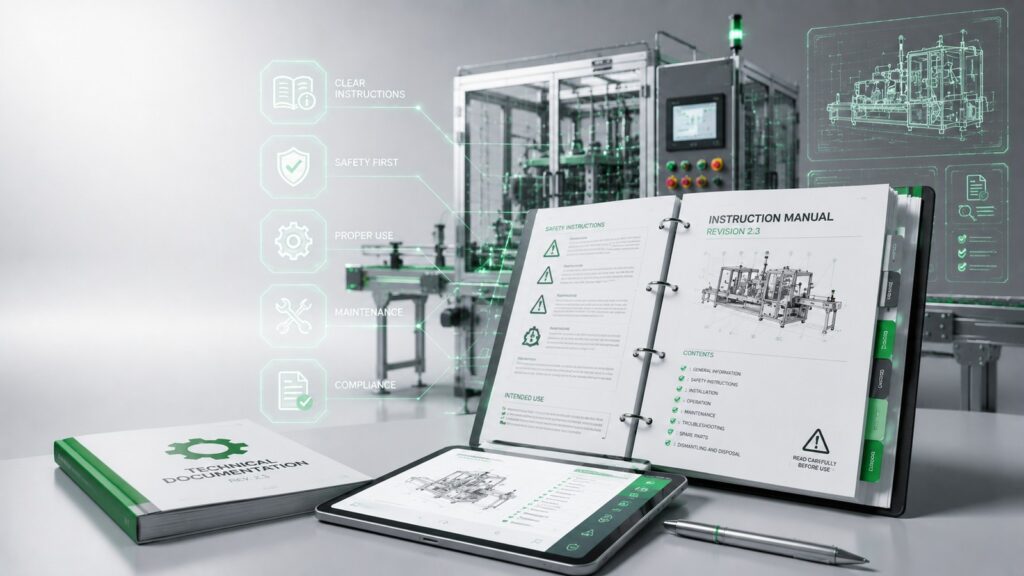
Instructions must allow the user to understand the machine, its limits and the correct conditions of use. The content depends on the type of machine, the expected life cycle and the residual risks, but in general a complete technical instructions for use should include at least the following sections.
| Instructions section | Expected content |
|---|---|
| Machinery identification | Designation, model, manufacturer details, year of construction, references to the declaration of conformity and the information required to identify the product. |
| Intended use and limits | Description of normal use, technical limits, environmental conditions, intended operators and reasonably foreseeable misuse. |
| Safety and residual risks | Warnings, pictograms, PPE, protective measures, safe procedures and information on risks that cannot be eliminated by design. |
| Installation and commissioning | Transport, lifting, assembly, connections, adjustments, preliminary checks and conditions for initial start-up. |
| Operation and adjustments | Operating sequences, controls, human-machine interface, operating modes, normal stopping, emergency stopping and fault management. |
| Maintenance and cleaning | Routine tasks, intervals, spare parts, lubrication, cleaning, energy isolation, LOTO and requirements for qualified maintenance personnel. |
| Faults and troubleshooting | Indications, error messages, likely causes, actions permitted to the operator and situations in which the manufacturer must be contacted. |
| Decommissioning | Dismantling, disposal, management of materials, batteries, fluids, electrical components and potentially hazardous parts. |
From residual risk to instructions: linking with risk analysis
The instructions for use must be consistent with risk assessment. Every significant residual risk identified in the analysis must find in the instructions for use a clear communication: who is exposed, in what phase of life, what behaviour is required and what measures should be respected.
The correct approach is not to write generic warnings, but to convert the results of the risk assessment into usable operating instructions. An effective warning must be specific, positioned in the correct part of the instructions for use and linked to the relevant procedure.
Waves practice rule. A instructions for use is strong when any safety information can be traced back to a design choice, a residual risk or a concrete phase of the machine life cycle.
EN ISO 20607: how to write clear and usable instructions
EN ISO 20607 provides general principles for the preparation of machine instructions for use. Its value is not only normative: it helps to build more readable documents, sorted and consistent with the way operators and maintenance teams actually consult the information.
- use a logical and stable structure;
- separate information by the machine's life phase;
- write procedures in sequence, avoiding too long texts;
- make clear warnings, prohibitions, obligations and hazards;
- use figures, tables and pictograms when they improve understanding;
- avoid vague wording such as ‘take care’ without specifying the actions required.
For complex machines, plants and integrated lines, the instructions for use should be designed as an information system: not only text, but procedures, schemes, maintenance tables, instructions for format change, alarm management, exchanges and cross-references.
Paper or digital instructions for use: what changes with the Machinery Regulation
Regulation (EU) 2023/1230 introduces a more explicit discipline for instructions in digital format. The manufacturer can also provide instructions in digital format, but it will have to ensure precise conditions: clear access, possibility to download and print, online availability for the expected period and free paper copy if required by the user at the time of purchase.
For machines intended for non-professional users, or reasonably suitable for non-professional users, the essential safety information must be provided in paper format.
This novelty does not mean that PDF can be uploaded online without method. The digital instructions for use must be controlled, revised, accessible, consistent with the version of the machine and also available in case of fault or impossibility of access to the integrated system.
Frequent errors in writing instructions for use
instructions for use copied by a similar machine, without real coherence with the project;
generic warnings not related to risk analysis;
lack of procedures for adjustment, cleaning, change of format and maintenance;
absence of instructions for energy insulation and access to dangerous areas;
technical language not suitable for actual operators;
incomplete or uncheckable maintenance tables;
instructions for use not aligned to electrical schematics, HMI, layout or final configuration of the machine;
translations not technically controlled.
How Waves Engineering supports manufacturers
Waves Engineering supports manufacturers, integrators and technical offices in the editing and review of instructions for use for industrial machines and plants, with an integrated technical approach: risk analysis, documentation verification, EN ISO 20607 structure, safety information, operational procedures and consistency with the technical file.
Our goal is not to produce a long document, but a really usable instructions for use, technically defendable and consistent with the built machine.
FAQ
Is the instructions for use mandatory for a CE machine?
Yes. Machines must be accompanied by the necessary instructions for use, installation, maintenance and safety. The instructions for use is part of the conformity documentation and must be consistent with the risk assessment.
Is EN ISO 20607 mandatory?
A harmonised standard is not "obligatory" in absolute sense, but applying it correctly helps the manufacturer to structure the instructions for use according to criteria recognized and consistent with the requirements of machine legislation.
Can the instructions for use be just digital?
Regulation (EU) 2023/1230 allows instructions in digital format, but with specific conditions. In addition, the paper copy must be provided free of charge at the request of the user at the time of purchase and the essential safety information must be printed in cases provided for non-professional users.
Should the instructions for use report all the remaining risks?
It must report the necessary information on the residual risks that remain after the design and adoption of protective measures, indicating behaviors, limitations, PPE and safe procedures.