Technical standards
Electrical testing of machinery according to EN 60204-1
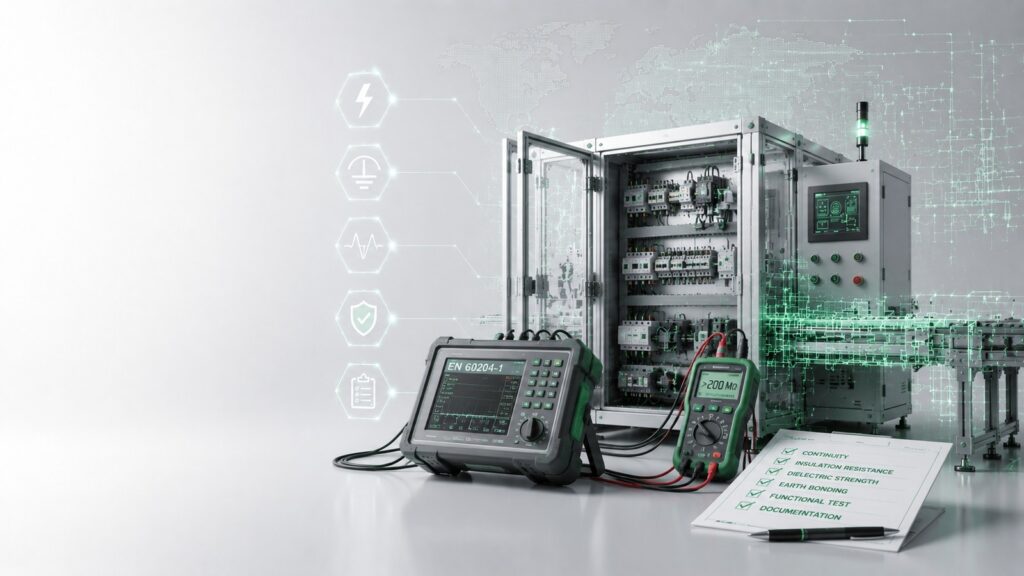
What electrical checks to perform on the machines according to EN 60204-1 and how to document the results.
Electrical equipment is one of the most critical parts of a machine. Non-compliant wiring, unverified protective measures or inconsistent electrical documentation can expose operators to risk and cause testing failures, installation disputes and gaps in the technical file. Reference
For this reason electrical tests should not be treated as a final formality, but as a structured phase of the machine verification process. EN 60204-1 standard provides the main reference for the electrical equipment of the machines.
Because electrical tests are fundamental
The electrical tests show that the real installation corresponds to the project and that the protection measures against electrical hazards have been verified. The result must be documented with a report, kept in the technical file and connected to the updated electrical schematics.
EN 60204-1 and electrical safety requirement
The electrical safety of the machines is treated by the applicable legislative requirements and, from the technical point of view, by EN 60204-1. The standard should not be applied in part or only declarative way: if it is recalled in the declaration of conformity, it is necessary to have evidence of the relevant checks.
Checks to plan
Documentary verification
The documentary review checks consistency between the as-built machine, electrical schematics, control cabinet layout, component identification, markings, rating plates, instructions for use and technical file. It is often the first step because a documentary error can make the results of subsequent tests difficult to interpret.
Continuity of the protective equipment circuit
The continuity of the protection circuit must be verified between the main PE clamp and the accessible masses or the protective points defined in the project. The test is to show that, in case of failure, the protection path is actually present and consistent.
Protection by automatic interruption
When protection against indirect contact is based on automatic disconnection of supply, it is necessary to ensure that the conditions of intervention are met. This may require visual verification, control of protection devices, calculations or measurements according to the system of distribution and configuration of the machine.
Functional testing
Functional tests verify that the electrical equipment allows the machine to carry out the required functions correctly: start, stop, emergency stop, reset, interlock, operating mode, alarms, blocks, resets and interactions with HMI. They must be planned in a manner consistent with the analysis of the risks and functions of the machine. Reference
Other tests to be evaluated
Depending on the machine and configuration of the electrical equipment other tests may also be relevant, such as insulation measures, voltage tests, verification of the protection against residual tensions or other checks required by the project, the customer or the target market.
Test report and technical file
The test value only exists if the result is traceable. This is why the report must be kept in the technical file along with the updated schematics, testing procedures and any calculations. In case of dispute, audit or verification by the customer, the report shows that electrical compliance has not only been declared, but actually verified.
How Waves Engineering supports manufacturers
Waves Engineering performs and documents electrical checks on machines and plants, supporting the manufacturer in the definition of the test plan, in the execution of tests, in the management of non-compliance and in the drafting of the report to be included in the technical file.
FAQ
Are electrical tests always mandatory?
The verifications must be planned according to the applied standard, electrical configuration and legislative requirements. If you declare EN 60204-1, you must have evidence of the relevant checks.
Is the PE continuity test alone?
No. It is an important verification, but it does not replace document verification, automatic protection, functional tests and other applicable tests.
Does the report have to be in the technical file?
Yes. Test reports must be kept as technical evidence of machine compliance.