Technical standards
Safety in machinery design: the three-step method
How to apply the method of three phases in the safe design of the machines according to EN ISO 12100.
Machinery safety should not be an afterthought. Adding guards, sensors and warnings only after a machine has been built can result in costly, poorly ergonomic solutions that are difficult to justify technically.
The method of the three phases, recalled by the logic of the Machinery Directive and the Regulation (EU) 2023/1230, provides a precise order to reduce the risk: first it eliminates or reduces the danger with the design, then protective measures are adopted, finally users are informed about the residual risks that cannot be eliminated.
Safety does not add to the end
A well-designed machine is a machine in which safety is integrated into function, accessibility, maintenance and interaction with the operator. This requires that risk analysis accompany the project from the first technical choices: layout, cinematism, access, materials, energy, maintenance, cleaning, format change and software.
The role of risk analysis
Risk analysis is not a document to be produced only for the technical file. It is the tool by which the manufacturer demonstrates that he has identified the hazards, estimated and assessed the risks, chosen appropriate reduction measures and verified the risks. Reference
EN ISO 12100 provides the technical reference method to perform this process systematically. The value of the document depends on the quality of technical reasoning, not the number of pages.
Step 1: Intrinsic safety
The first step is to design the machine so as to eliminate or reduce the hazards to the source. It is the most important phase, because it intervenes before the risk is delegated to guards, sensors or instructions.
- reduce forces, speed, temperatures or dangerous energies when possible;
- eliminate edges, crushing points or unnecessary access;
- choose less dangerous cinema solutions;
- make safer maintenance, cleaning and adjustment;
- design ergonomic and logical access.
Step 2: Protective measures
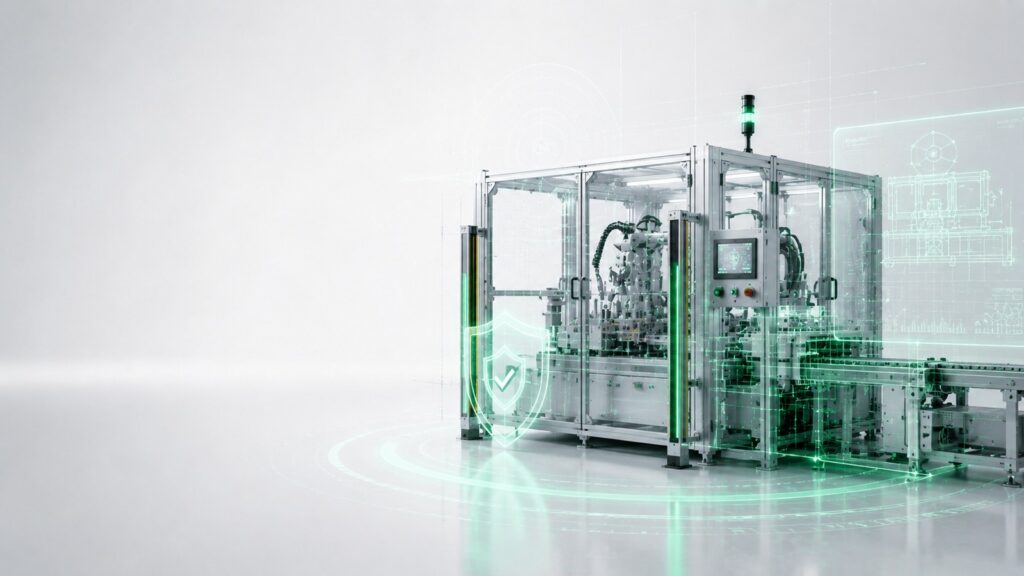
When intrinsic safety is not enough, protective measures are adopted: fixed guards, interlocked movable guards, photoelectric barriers, two-hand controls, safety functions, arrest devices and safety-related control systems.
At this stage it is essential to correctly design both the mechanical part and the control part. Safety functions must be sized and validated according to the risk they need to reduce, for example through the calculation of the Performance Level according to EN ISO 13849-1.
Step 3: information for use
Information measures include instructions for use, pictograms, plates, warnings, procedures, training and operational instructions. They are indispensable, but should not be used to compensate for risks that could be eliminated or reduced with a better design.
Remnants and documentation
When, after the application of the three stages, there are no further risks that can be reasonably reduced, these risks must be documented and communicated. The instructions for use must explain where they are, when present, what people are exposed and what measures must be taken. Reference
Frequently Errors
drawing up risk analysis after already completing the project
skip intrinsic safety and immediately switch to guards and sensors
do not consider maintenance, cleaning, change format and failure
describe residual risks in a generic way
do not connect risk analysis, instructions for use, technical file and safety circuits.
How Waves Engineering supports manufacturers
Waves Engineering supports manufacturers in the safe design of machines, starting from risk analysis and reaching the definition of technical measures, the verification of safety circuits, the drafting of the technical file and the instructions for use.
FAQ
What is the method of the three stages?
It is the risk reduction method that provides, in order, intrinsic safety, protection measures and information for use.
Can instructions replace guards?
No. Instructions are fundamental to manage residual risks, but do not replace necessary technical measures when technically applicable.
When should the risk analysis be done?
From the initial phase of the project and then updated during development, construction, testing and modification of the machine.